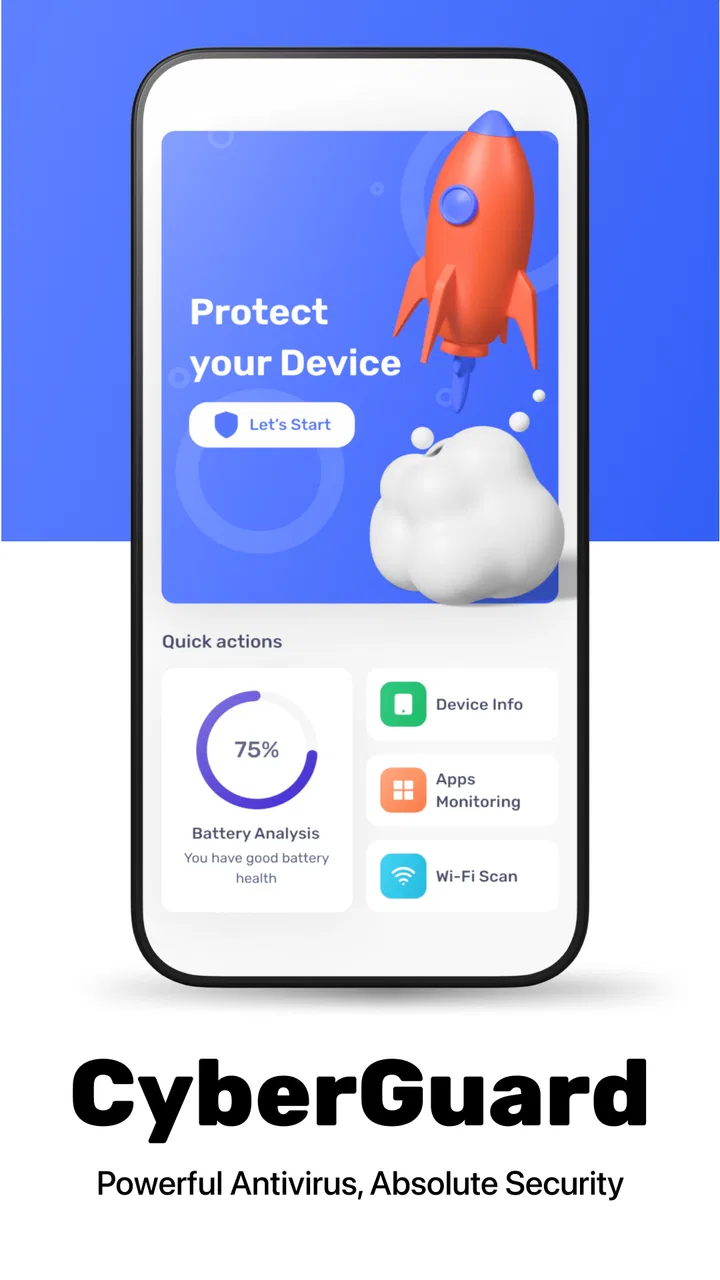
Cyber Guard Antivirus
- 4.3
- Rating
- 100.00K
- Installs
- Free
- Price

 Analysis by App-foxy
Cyber Guard Antivirus is the kind of Android tools app that makes a strong first impression because its purpose is immediately clear: it is meant to add a layer of protection between your phone and potentially unsafe software or activity. I spent time looking at it not just as something to install and forget, but as a utility that has to earn a permanent place on a phone. Security apps often feel useful during the first few days, then become background clutter. The more important question is whether this one remains practical after the novelty fades.
My overall experience is that Cyber Guard Antivirus is easiest to appreciate when you want a straightforward security companion rather than a large, complicated suite. It belongs to the Tools category, comes from medonia ltd, and is available free of charge, although some parts may involve in-app purchases priced at $9.99 per item. That combination makes it accessible for trying without an immediate commitment, while also giving you a reason to pay attention to which functions you actually use before spending anything.
What the first week feels like
The first week is when an antivirus app has to prove that it is more than a reassuring label. I would begin by installing it on a phone used for normal daily tasks: messaging, browsing, downloading documents, and trying occasional apps. That kind of mixed routine is more revealing than testing it on a device that only runs familiar software. The main value at this stage is having a dedicated place to check the device instead of relying entirely on memory or guesswork.
You May Also Like

 Blood Strike: 2.5 Anniversary
Blood Strike’s Loadouts Turn Every Drop Into a Tactical Gamble
A close look at Blood Strike’s custom loadouts: how fast access to signature weapons reshapes its battle royale rhythm, rewards preparation, and narrows the gap between fights.

 Pandora - Music & Podcasts
Pandora’s Music Is Easy to Start, but Harder to Recover
Pandora’s strength is its low-effort path from a seed to a station. Its weak spot is how much confidence it asks you to place in connection, setup, and quiet recovery.

 8 Ball Pool
 Is Built on Rivalries, Rematches, and Routine
A close look at the rivalries, rematches, shared routines, and unanswered safety questions that turn a quick pool match into a persistent mobile community.

 Samsung Music
’s Quiet Strength Is Playing What You Already Own
Its reach comes less from spectacle than from dependable access to a personal library. That simplicity is both the app’s strongest retention engine and its ceiling.

 AccuWeather: Weather Radar
AccuWeather Review: A Quick, Clear Forecast for Everyday Decisions
For everyday plans, the best forecast is the one you can understand quickly. AccuWeather makes rain timing, radar, and local conditions easy to act on, with a few trade-offs.

 Hill Climb Racing
Why Hill Climb Racing Still Turns Crashes Into One More Run
A tiny car, a bumpy hill and one more upgrade: Hill Climb Racing keeps resurfacing because its simple chaos makes every near-miss feel personal.
More From Our News Desk



The app’s presentation is approachable enough for people who do not normally think about mobile security. You do not need to be a technical user to understand why a scan or a security check might be useful. This matters because the best protection tool is often the one a person will actually open when something feels unusual, such as an unexpected warning, a suspicious download, or an app that behaves differently after installation.
I would not treat the presence of an antivirus app as permission to ignore ordinary caution. Cyber Guard Antivirus can support safer habits, but it cannot turn every download into a safe one or remove the need to check where an app came from. My first-week routine would therefore be simple: run a check after installing unfamiliar software, review anything that looks questionable, and avoid approving requests without reading them. The app is most useful as a prompt for better decisions, not as a substitute for them.
Its audience is broad. The Everyone content rating makes it suitable for a general household audience, and the minimum operating-system requirement of Android 8.0 keeps it relevant to many older phones that are still in daily use. That is a practical advantage for families or for anyone keeping a reliable older handset rather than replacing it every year. At the same time, people using very new devices with strong built-in security tools may wonder whether they need another layer at all.
The app has reached over one hundred thousand installs and holds an average rating of 4.3 from more than six hundred ratings, with over one hundred written reviews. Those figures suggest that it has found a real audience, but I would read them as a reason to investigate rather than as proof that it will suit every phone. Security needs vary widely depending on how someone installs apps, where they browse, and whether the device is shared with other people.
A realistic everyday test
Imagine that I am helping a relative whose phone is used for banking, shopping, social media, and downloading forms from email. They are not interested in technical settings, but they do occasionally tap links quickly. In that situation, I would set up Cyber Guard Antivirus as a regular checkpoint. After a new app is installed, I would encourage them to open the security tool and perform a check rather than waiting for a problem to become obvious.
The useful part of this workflow is not dramatic intervention. It is the change in behavior. A visible security routine can make a person pause before installing something unfamiliar. That pause is valuable because many mobile-security problems begin with rushed choices, misleading download pages, or software that does not deserve trust. If the app helps create that habit without making the phone feel difficult to use, it has already earned some value.
For my own phone, I would use it differently. I would not open it repeatedly throughout the day. Instead, I would keep it available for occasional checks tied to specific events: installing software from an unfamiliar source, receiving a suspicious attachment, or noticing unusual behavior. This is an important trade-off. A security app that demands constant attention may create fatigue, while one used only when there is a sensible reason can remain helpful without taking over the routine.
Where it compares well with ordinary alternatives
The usual alternative is to rely only on the security protections already built into Android and to manage downloads carefully. That approach has the benefit of simplicity: fewer apps, fewer notifications, and less time spent maintaining another tool. For a cautious user who installs only familiar software, keeps the phone updated, and never downloads from questionable places, the built-in approach may be enough.
Cyber Guard Antivirus makes more sense for someone who wants an additional, clearly visible security checkpoint. It gives that person a dedicated tool to open when they feel uncertain. Compared with a full security suite, its appeal is its narrower identity. A large suite may combine security with privacy controls, device management, cleanup tools, or account services, but that can also make the experience feel crowded. I prefer a focused utility when I am trying to answer one question: does this phone need a security check right now?
The limitation is that a focused antivirus app may not replace every protection a broader suite offers. If you specifically want a password manager, extensive identity monitoring, or a complete device-management package, this is probably not the right starting point. I would choose it for a clear security purpose, not because the word “all-in-one” creates an expectation that every mobile-protection need will be covered.
Whether it still earns space after the first month
After the first month, I’d judge Cyber Guard Antivirus by whether it still gives me a useful checkpoint when my phone habits change, not by how often I open it. A quiet month may be a sign that I simply have fewer unfamiliar downloads to review, rather than a reason to scan more. I’d also pay attention to whether its current version, 1.28, continues to fit comfortably into my routine as I decide what deserves space on the phone.
Month-to-month value depends on your habits
After the first month, the excitement of installing a new security tool disappears. That is when Cyber Guard Antivirus has to justify its place through recurring usefulness. In my view, its long-term value depends less on opening it every day and more on whether your phone activity changes from week to week. Someone who regularly tests new apps, receives files from many contacts, or helps manage several devices has more reason to keep a dedicated security tool close at hand.
For a stable phone that runs the same trusted apps, the value is quieter. You may not see a daily benefit, and that can make the app feel unnecessary. Security is an awkward category because success often looks like nothing happening. I would judge the app by whether it gives me a sensible way to check the phone when circumstances change, rather than expecting constant visible activity.
A practical monthly routine would be to combine the app with a short personal review. I would remove apps I no longer use, inspect recent downloads, check whether anything unfamiliar has appeared, and then run a security check. This is one of the less obvious ways to get more from the app: pair it with cleanup decisions instead of treating it as an isolated button. The scan becomes part of a broader maintenance habit, while the maintenance itself reduces the number of things that need watching.
I would also avoid turning every minor phone slowdown into evidence of infection. Performance changes can come from storage pressure, aging hardware, connectivity problems, or an app that is simply poorly designed. Cyber Guard Antivirus may be useful during that investigation, but it should be one step in the process. Removing unused software, restarting the phone, and checking recent changes can be just as important as opening the security tool.
The free entry point and the purchase decision
Because the app is free to install, I can evaluate its everyday fit before deciding whether any paid item is worthwhile. That is the right approach here. I would not buy an in-app item merely because security sounds urgent. First I would use the free experience long enough to understand which actions I repeat, which information is easy to interpret, and whether the app actually changes how I manage the phone.
The listed in-app purchase price of $9.99 per item is meaningful enough that I would want a clear personal benefit before paying. A user who only opens the app once and forgets it is unlikely to get good value. Someone who uses it as part of a regular family-support routine may see the purchase differently, especially if a particular paid function saves time or provides a capability they genuinely need. The decision should come from repeated use, not from fear.
This is also where the app’s simple positioning can work in its favor. If you dislike subscriptions or broad bundles, paying for a specific item may feel easier to understand than committing to a large security ecosystem. On the other hand, users who want every protection feature included in one predictable package may prefer a competing product with a clearer all-inclusive structure. I would compare the actual functions you need, not just the initial price.
Maintenance is light, but not invisible
No antivirus app is truly install-and-forget if you want to use it responsibly. Cyber Guard Antivirus still needs occasional attention from the person holding the phone. I would keep its role limited and deliberate: open it when installing unfamiliar software, after a questionable download, or during a monthly device check. That schedule avoids the common mistake of scanning compulsively without changing anything else.
There is another maintenance issue that is easy to overlook: deciding what to do with a warning. A security result is only useful if I understand the next step. I would avoid immediately deleting something important just because it looks unfamiliar. First I would consider whether I installed it intentionally, whether it came from a source I trust, and whether the timing matches the problem I noticed. If the answer is unclear, I would preserve important files elsewhere before taking a destructive action.
That caution is especially important on a shared phone. One person may install an app that another person does not recognize, creating confusion during a review. I would establish a simple household rule: tell the others before removing software, and keep copies of essential documents outside the device. The app can support the check, but good communication prevents a security routine from becoming an accidental data-loss routine.
Where long-term fatigue can appear
The first source of fatigue is repetition. If every visit feels like the same check and nothing in your phone changes, you may stop opening the app. That is not necessarily a failure; it may simply mean your risk profile is low. The sensible response is to use the tool less often, not to create artificial reasons to scan.
The second source is uncertainty about paid functions. A free app with optional purchases can leave users wondering whether the basic experience is enough or whether they are missing something essential. I would deal with that by identifying a specific need first. If I cannot name the problem a purchase solves, I would keep using the free version or choose a different tool whose pricing and scope are easier for me to understand.
The third source is overlapping protection. Android already includes security measures, and many phone manufacturers add their own device-care features. Running several tools that perform similar checks can make the phone feel busier without giving a proportional improvement. Cyber Guard Antivirus is a better fit when it fills a gap in your routine, not when it duplicates three other security dashboards.
There is also a psychological limitation. Antivirus branding can encourage people to believe that threats are being handled automatically. I would resist that assumption. Safe downloading, careful link handling, timely system updates, and sensible account protection remain central. If you want an app that teaches you to think about those habits, this one can be part of the process. If you want complete protection without any personal attention, no mobile antivirus should be treated as a guarantee.
Who should keep it installed
I would recommend keeping Cyber Guard Antivirus on a phone used by someone who frequently experiments with apps, handles attachments, or wants an easy security checkpoint without adopting a large suite. It also makes sense for people who help less technical relatives, because a dedicated tool gives you a shared reference point when discussing a suspicious download or an unexpected change.
It is less convincing for a highly cautious user whose phone already has strong built-in protection and whose software habits are extremely conservative. That person may gain more from reducing duplicate utilities and learning the existing security controls thoroughly. I would also hesitate to recommend it as the only reason to feel safe on a phone used for highly sensitive work. In that case, device updates, account security, organizational policies, and professional support matter as much as an antivirus check.
For older Android hardware, the Android 8.0 minimum is helpful because it does not automatically exclude every aging device. Still, I would watch how the phone feels after adding any security tool. Older hardware has less room for background utilities, and a tool is not worthwhile if it makes everyday tasks frustrating. The right test is practical: use the phone normally for several days and decide whether the added reassurance comes with noticeable inconvenience.
My long-term verdict
Cyber Guard Antivirus earns a place on my recommended shortlist, but not as an automatic installation for every Android user. Its strongest quality is the clear role it can play in a careful routine: check unfamiliar software, investigate odd behavior, and make security part of ordinary phone maintenance. The free entry point makes that evaluation easy, while the Everyone rating and Android 8.0 requirement keep it approachable for a broad audience.
Its lasting value is therefore conditional. I would keep it installed when I regularly deal with new downloads, support another person’s phone, or want a dedicated security checkpoint that is separate from the system’s built-in tools. I would remove it if it merely duplicates protections I already understand, creates more worry than clarity, or becomes an app I never open.
My final advice is to give it a real trial based on your own routine rather than judging it after one scan. Use it alongside careful download choices, review your installed apps occasionally, and decide whether the app helps you maintain the phone with less uncertainty. The best reason to keep Cyber Guard Antivirus is not novelty; it is a repeatable habit that remains useful when your phone, your downloads, or the people using the device change.
FAQs for Cyber Guard Antivirus
01What is Cyber Guard Antivirus and what does it do?
Cyber Guard Antivirus is designed to help protect Android or iOS devices from common digital threats, including suspicious applications, harmful files, unsafe links, and potential privacy risks. After reviewing its security tools, the app appears focused on providing accessible protection for everyday users rather than replacing complete security practices. Its effectiveness can depend on device permissions, operating-system support, database updates, and whether the most useful features require a subscription.
02Does Cyber Guard Antivirus provide real-time protection?
Cyber Guard Antivirus may offer real-time monitoring, but the exact features can vary depending on the device platform, app version, and selected plan. Before downloading, users should check whether continuous scanning, automatic threat detection, web protection, and background monitoring are included. Real-time security can also affect battery usage and performance, so it is worth reviewing the app’s settings and permission requests before enabling every protection feature.
03Is Cyber Guard Antivirus free to download and use?
Cyber Guard Antivirus may be available as a free download, although some advanced tools can be restricted behind in-app purchases or a subscription. Typical premium features may include stronger web protection, privacy checks, unlimited scanning, automatic updates, or removal of advertisements. We recommend checking the store listing carefully for trial periods, renewal terms, and cancellation instructions so you understand the total cost before activating a paid plan.
04Is Cyber Guard Antivirus safe to install on my phone?
The application should be downloaded only from the official Google Play Store or Apple App Store, where the publisher information, permissions, ratings, and privacy details can be reviewed. During testing, users should pay attention to requests for accessibility access, device administration, VPN configuration, storage, or personal information. Security apps often need certain permissions, but requests should be relevant to their stated functions and clearly explained.
05Can Cyber Guard Antivirus remove viruses and protect my personal data?
Cyber Guard Antivirus may help identify or remove certain malicious files and applications, but no antivirus app can guarantee complete protection against every threat. Its privacy and security tools should be treated as an additional layer alongside system updates, strong passwords, two-factor authentication, and cautious browsing. Users should also avoid installing unknown APK files, opening suspicious links, or granting sensitive permissions to untrusted applications.
Pros
- Real-time scanning helps detect suspicious apps and files quickly.
- Includes tools to check links and websites before opening them.
- Simple interface makes essential security features easy to find.
- Can help identify apps requesting excessive or unusual permissions.
- Useful extra protection when installing apps outside official stores.
Cons
- Some features may require a premium subscription.
- Security scans can increase battery use during intensive checks.
- Background protection may affect performance on older devices.
- Results can include occasional false alarms for harmless files.
- A stable internet connection may be needed for cloud-based checks.

Cyber Guard Antivirus
Gallery